
The Long and the Short of it: what the 60/40 rule means for your brand
Part of our series on growing your brand without a giant budget.
In our last post, we explained the 95/5 rule, the finding that only around 5% of your market is ready to buy at any given moment, and that the other 95% are tomorrow’s customers rather than today’s. That idea sits alongside another piece of research every ambitious brand should know: the 60/40 rule. Put the two together and you have a genuinely useful map for how to spend your budget.
Where the 60/40 rule comes from
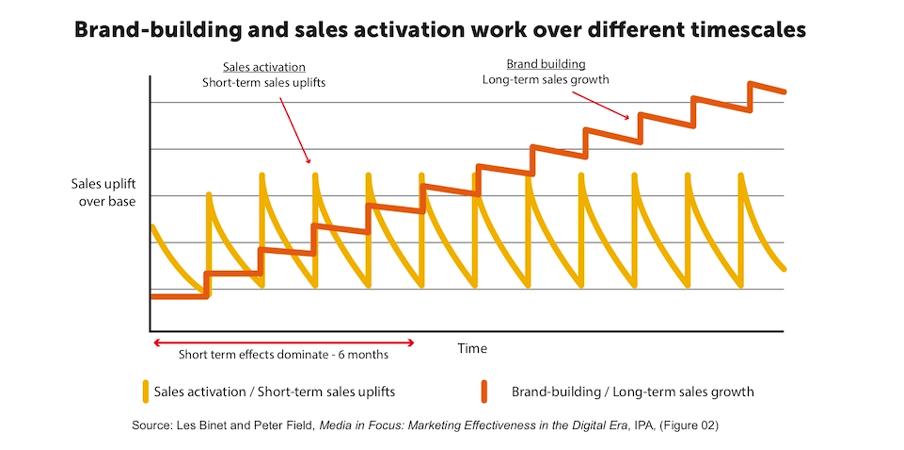
The rule was published by Les Binet and Peter Field in 2013 on behalf of the IPA, drawn from an analysis of close to 1,000 UK advertising effectiveness case studies collected from 1980 onwards. Their finding was that, on average, the most effective campaigns split their budget around 60% towards long-term brand building and 40% towards short-term sales activation. Binet and Field call this “the long and the short of it”: long-term brand building and short-term activation are not rivals, they are two halves of the same job, and both need funding.
Two rules that apply to every brand
Before getting into ratios and context, it is worth being clear on the two things Binet and Field say hold true for every brand, in every category, no exceptions.
- All brands need brand building. It is the main driver of long-term growth, working by creating the memory structures that prime people to want to choose you. Without it, activation grows weaker, pricing power stalls, and profitability suffers.
- All brands need sales activation. It drives the short-term uplifts that keep the business moving today, and it works harder precisely because brand building has already done the groundwork. Strip it out and growth suffers too.
Neither one is optional, to ensure profitable brand growth you need to use both in a balanced way for your business.
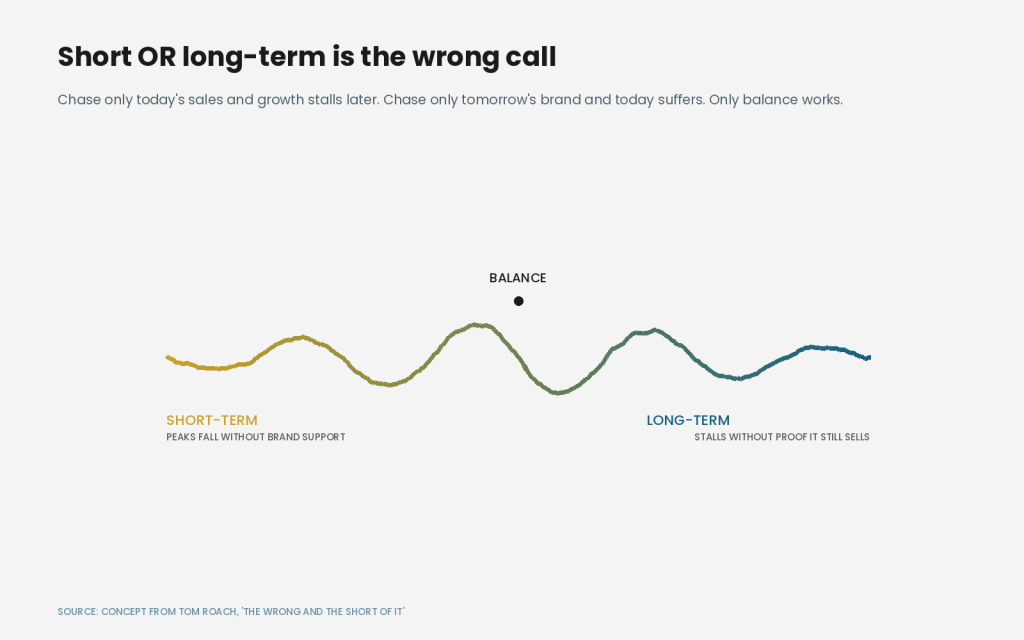
Marketing consultant Tom Roach has a good name for the alternative: “wrong-termism”. Treating short-term and long-term as a choice, rather than a partnership, fails in two different ways, not one. Short-termism restricts how much a brand can grow. Long-termism, chased alone, restricts how much it sells today. Only the two working together avoid both traps.
Why the split matters so much
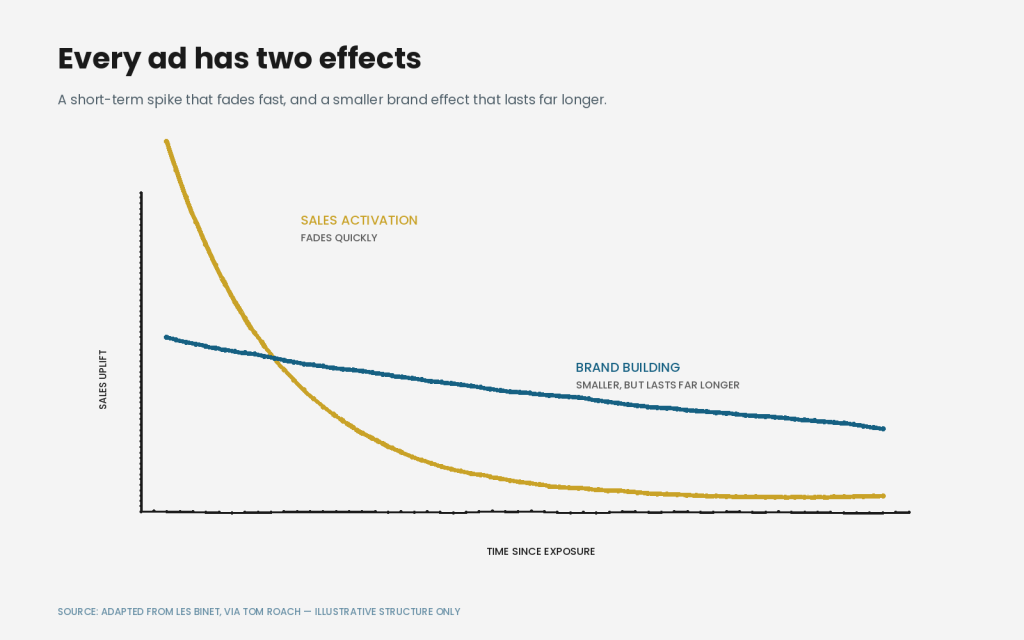
Brand building, the long game, works by creating memories, associations and emotional connections that make a brand easy to choose later. Its returns compound over time.
Activation, the short game, is the sharp-elbowed work of converting people who are ready to buy right now, and its returns tend to be immediate but do not build on themselves in the same way.
Binet and Field’s research found that brands leaning too heavily on activation alone saw short bursts of sales followed by a decline in underlying brand strength, while those investing properly in the long game grew more efficiently, and more sustainably, over years rather than weeks.
Is this the 95/5 rule wearing a different hat?
Look closely and the two frameworks describe the same market from different angles. The 95% of buyers who are not ready to purchase today are exactly who long-term brand building is for: the investment that keeps you front of mind until their moment arrives. The 5% who are in market right now are exactly who short-term activation is built to convert. A budget with no long-term brand spend is a budget that has quietly written off the 95% of your future customers who are still out there, simply not ready yet.
Binet and Field make the connection explicit themselves. Their research states that penetration growth, winning new buyers rather than simply deepening loyalty among the customers you already have, is always the main driver of growth, and that loyalty does not increase without penetration first. That is the 95/5 rule again, in their own words: growth comes from reaching the people you have not won yet.
Why performance marketing on its own hits a ceiling
It is easy to see why so many budgets drift towards activation. It is measurable, easy to defend in a meeting, and the results land in days rather than months. But chasing only the buyers who are ready right now means competing for the same small, in-market audience as every one of your rivals, in the most expensive, most crowded auction there is. Costs climb, returns shrink, and growth stalls, the pattern we described in our previous post as the “CAC Valley of Death”. Performance advertising is brilliant at capturing demand. It is not built to create it.
Tom Roach illustrates what this looks like in practice with two scenarios. Shift a brand that has leaned too hard on activation towards a proper 60/40 balance, and short-term peaks can dip briefly before both base sales and peak performance start climbing together as the brand strengthens. Shift back the other way, often when a new leader “does not believe in doing brand marketing”, and the pattern reverses: peaks shrink and base sales quietly drop away. It is a cautionary tale worth keeping in your back pocket the next time someone asks why the brand budget matters.
Not an iron law
Binet and Field have always been clear that 60/40 is a strong average, not a rule to follow blindly. Their later work, Effectiveness in Context, showed the ideal split shifts by sector and situation: closer to 50/50 for online-only brands, and roughly 46% brand to 54% activation for B2B businesses, based on their research with LinkedIn’s B2B Institute.
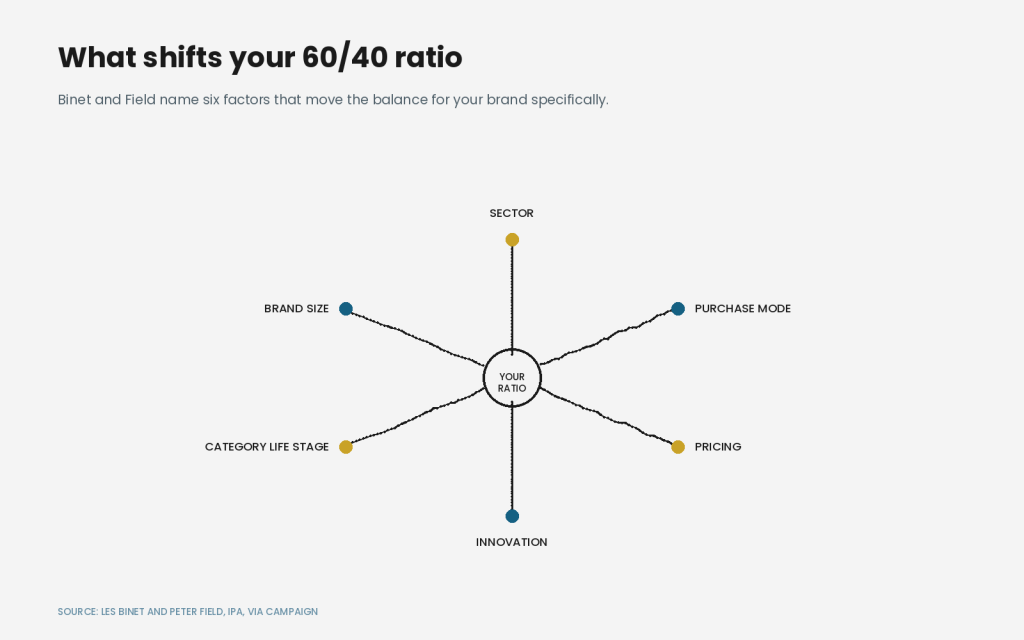
That same research, reported by Campaign, goes further and names six contextual factors that shift the ideal ratio for any given brand.
- Which sector the brand competes in
- How the brand is bought
- How the brand is priced
- How innovative the brand or product is
- The life stage of the category, whether it is emerging, mature or in decline
- The size of the brand itself
Category, brand size, loyalty and how established you already are in your market all move the dial. The number to take away is not 60, it is the principle: both halves need a home in your plan, and where exactly the balance sits is worth working out for your own brand rather than assuming.
It is worth being honest about how firm this actually is, too. The 95/5 rule has been tested and repeated across fifty years of category data, so that figure barely moves wherever you look. The 60/40 rule is a different kind of evidence: a strong average drawn from real campaigns, not a fixed mathematical law, and critics have pointed out it is genuinely harder to test, you can never fully know what a different split would have delivered. That does not make it less useful. It makes it a strong starting point to adapt for your own brand, not a number to follow blindly.
What this means for your budget
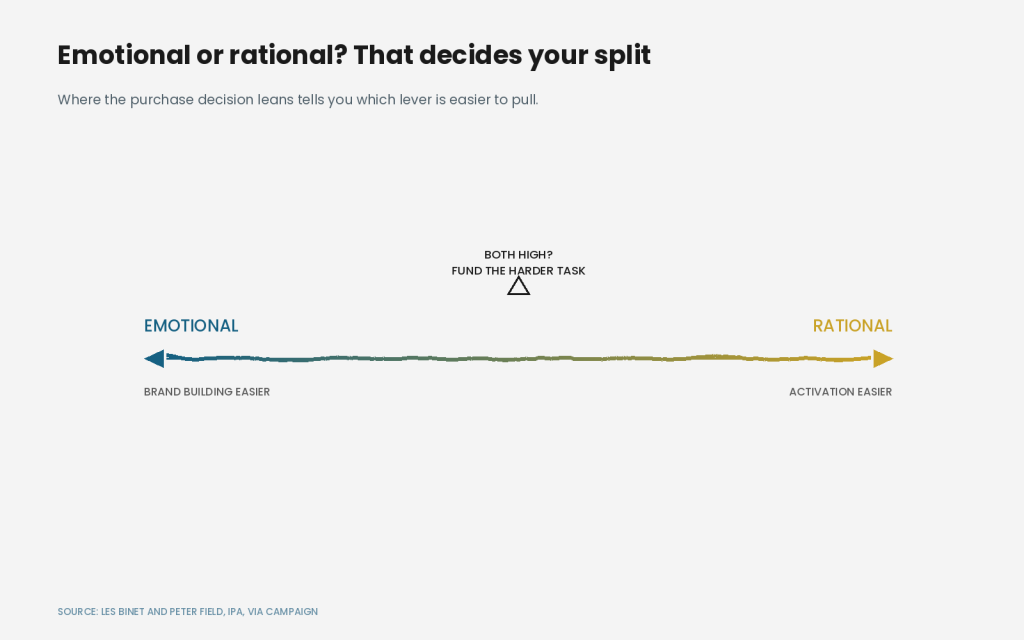
A useful starting point is to ask how emotional or how rational your customers’ decision really is. Binet and Field’s research points to this as the clearest rule of thumb for finding your own split. Where people choose you on how you make them feel, trust, desire, identity, brand building is the easier lever to pull and probably deserves the bigger share of budget. Where they choose you by comparing price, features or specifications, activation is the easier win. And where a decision genuinely involves plenty of both, their advice is to put more budget behind whichever task is harder for your category, not whichever one is easier to justify in a meeting.
If your marketing is entirely search, paid social and email, you are almost certainly over-indexed on the short game. Even a modest, deliberate slice of spend on brand-building media, be that radio, out of home, press or a well-made piece of video, gives future buyers a reason to remember you when their moment comes. You do not need to flip your whole budget overnight. You need to make sure some of it is quietly working for the customers you have not won yet.
One practical way to check whether it is working: share of search. Les Binet and James Hankins have found that a brand’s share of Google searches within its category can predict its market share across a wide range of sectors, and it is one of the few metrics that speaks to both sides of the divide at once. Brand people read it as fame and mental availability. Performance people read it as high-intent traffic.
Not sure how your own split stacks up?
If you are trying to grow your business, become less depended on performance ads or expand brand penetration, this is a great time to have a consultation with Hurst Media Agency and we will help you find the right balance of long and short for your brand and your budget. Drop us an email at sales@hurstmediaagency.co.uk and we will be happy to chat about what would work for you.
Sources and further reading:
- Campaign, “Binet and Field reveal key formulas for brand-building”: https://www.campaignlive.co.uk/article/binet-field-reveal-key-formulas-brand-building/1495641
- Tom Roach, “The Wrong and the Short of it…again”: https://thetomroach.com/2024/06/15/the-wrong-and-the-short-of-it-again/
- ColourText, “Unraveling the clash between the Ehrenberg-Bass Institute and Binet and Field’s popular 60/40 rule”: https://colourtext.com/opinion/unraveling-the-clash-between-the-ehrenberg-bass-institute-and-binet-and-fields-popular-60-40-rule/
How to Measure Results on a Small Budget – Hurst Media Agency
[…] we set out in our post on The Long and the Short of It, most smaller advertisers only ever measure the first, simply because it is the easier one to […]
How Much Should You Actually Be Spending on Marketing? – Hurst Media Agency
[…] activation, rather than letting a zero-based process quietly strip the brand half out. Work out how the 60/40 rule we set out in The Long and the Short of It needs to look for you in order to achieve short and long term […]